
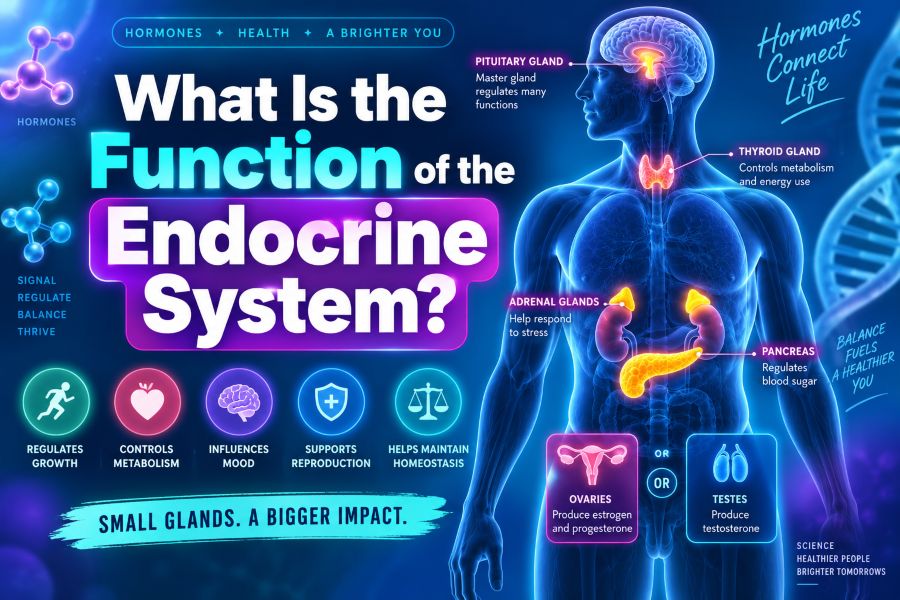
The endocrine system is one of the body’s major communication and control systems. It is made up of glands and tissues that produce hormones, which are chemical messengers that travel through the bloodstream and influence many different organs and processes.
So, what is the function of the endocrine system?
The main function of the endocrine system is to regulate and coordinate important body processes through hormones. These processes include growth, metabolism, reproduction, stress response, blood sugar control, sleep, mood, fluid balance, and sexual development.
Unlike the nervous system, which can send very fast electrical signals, the endocrine system generally works more slowly. However, its effects can last much longer. Hormones can influence the body for minutes, hours, days, or even years.
Understanding how the endocrine system works helps explain how the body maintains balance and adapts to changes.
What Is the Endocrine System?
The endocrine system is a network of glands and hormone-producing tissues located throughout the body.
These glands release hormones directly into the bloodstream. Once released, the hormones travel to specific cells, tissues, or organs known as target cells or target organs.
Hormones only affect cells that have the correct receptors for them. This allows the endocrine system to send very specific instructions throughout the body.
Some of the most important endocrine glands include:
- Hypothalamus
- Pituitary gland
- Pineal gland
- Thyroid gland
- Parathyroid glands
- Adrenal glands
- Pancreas
- Ovaries
- Testes
Other organs, including the kidneys, heart, digestive tract, and fat tissue, can also produce hormones.
What Is the Function of the Endocrine System?
The endocrine system has many functions, but its overall purpose is to help regulate the body and maintain internal stability.
It does this by producing hormones that control important processes.
1. Regulating Metabolism
One of the main functions of the endocrine system is regulating metabolism.
Metabolism refers to the chemical processes the body uses to convert food into energy and maintain normal cell function.
The thyroid gland plays a major role in this process.
It produces thyroid hormones, including thyroxine, also known as T4, and triiodothyronine, known as T3.
These hormones influence how quickly the body uses energy.
When thyroid hormone levels are too high, metabolism may become faster. When they are too low, metabolism may slow down.
This can affect:
- Body weight
- Energy levels
- Heart rate
- Body temperature
- Digestion
The endocrine system helps keep these processes within a healthy range.
2. Controlling Growth and Development
The endocrine system also plays an essential role in human growth and development.
The pituitary gland produces growth hormone, which supports the development of bones, muscles, and other tissues.
During childhood and adolescence, growth hormone is especially important.
Other hormones, including thyroid hormones and sex hormones, also contribute to normal development.
For example, during puberty, changes in hormone levels lead to the development of secondary sexual characteristics.
These may include:
- Changes in body shape
- Growth of body hair
- Voice changes
- Breast development
- Increased muscle mass
- Development of reproductive organs
The endocrine system helps ensure that these changes occur at the appropriate stages of life.
3. Regulating Blood Sugar
Another important endocrine function is controlling blood glucose levels.
The pancreas produces two key hormones involved in this process:
- Insulin
- Glucagon
Insulin helps lower blood sugar by allowing glucose to move from the bloodstream into cells, where it can be used for energy or stored.
Glucagon generally works in the opposite direction. It helps raise blood sugar when levels become too low.
Together, insulin and glucagon help maintain stable blood glucose levels.
This balance is extremely important because both very high and very low blood sugar levels can cause health problems.
4. Managing the Stress Response
The endocrine system helps the body respond to physical and emotional stress.
The adrenal glands, located above the kidneys, produce several hormones involved in stress responses.
These include:
- Adrenaline
- Noradrenaline
- Cortisol
Adrenaline can increase heart rate, breathing rate, and blood flow to muscles during stressful situations.
Cortisol helps the body manage longer-lasting stress by affecting blood sugar, metabolism, immune activity, and energy availability.
This response can be helpful during emergencies or challenging situations.
However, long-term disruption of stress hormones may affect overall health.
5. Supporting Reproduction
The endocrine system is essential for reproduction.
In females, the ovaries produce hormones such as estrogen and progesterone.
These hormones help regulate:
- Menstrual cycles
- Ovulation
- Pregnancy
- Sexual development
In males, the testes produce testosterone.
Testosterone contributes to:
- Sperm production
- Muscle development
- Bone health
- Sexual development
- Libido
The pituitary gland also produces hormones that regulate the ovaries and testes.
These include follicle-stimulating hormone, or FSH, and luteinizing hormone, or LH.
Together, these hormones help coordinate reproductive function.
6. Maintaining Fluid and Electrolyte Balance
The endocrine system helps regulate the amount of water, sodium, potassium, and other substances in the body.
One important hormone is antidiuretic hormone, also called ADH.
ADH helps control how much water the kidneys retain.
Another hormone, aldosterone, helps regulate sodium and potassium levels.
These hormones are important for maintaining:
- Blood pressure
- Hydration
- Nerve function
- Muscle function
- Normal circulation
Without proper hormonal regulation, fluid and electrolyte levels can become unbalanced.
7. Regulating Blood Pressure
Several hormones help control blood pressure.
The adrenal glands, kidneys, pituitary gland, and other organs all contribute to this process.
Hormones can influence blood pressure by changing:
- Blood vessel diameter
- Heart rate
- Fluid retention
- Sodium balance
For example, aldosterone can cause the kidneys to retain sodium, which can increase water retention.
The renin-angiotensin-aldosterone system also helps regulate blood pressure and fluid levels.
This demonstrates how the endocrine system works closely with the cardiovascular and urinary systems.
8. Controlling Sleep and Circadian Rhythms
The endocrine system also influences sleep.
The pineal gland produces melatonin, a hormone involved in regulating the sleep-wake cycle.
Melatonin levels usually rise in the evening as darkness increases and fall during daylight.
This helps signal to the body that it is time to sleep.
The body’s natural daily rhythm, known as the circadian rhythm, affects many processes, including:
- Sleep
- Body temperature
- Hormone release
- Metabolism
- Alertness
Hormones are an important part of this internal biological clock.
9. Influencing Mood and Behavior
Hormones can also affect mood, emotions, and behavior.
Changes in hormone levels may influence:
- Energy
- Motivation
- Anxiety
- Irritability
- Concentration
- Sexual drive
For example, thyroid hormones can affect energy and mood.
Cortisol is closely connected with stress.
Sex hormones such as estrogen and testosterone can also affect emotional and behavioral processes.
Hormones do not control every emotion, but they are an important part of the complex biological systems that influence mood.
10. Supporting Bone Health
The endocrine system plays a major role in bone development and maintenance.
Several hormones are involved, including:
- Parathyroid hormone
- Calcitonin
- Estrogen
- Testosterone
- Growth hormone
- Vitamin D-related hormones
The parathyroid glands help regulate calcium levels in the blood.
Calcium is essential for:
- Bone strength
- Muscle contraction
- Nerve signaling
- Blood clotting
Hormonal balance is therefore important for maintaining strong bones throughout life.
Major Glands of the Endocrine System and Their Functions
Understanding the major endocrine glands makes it easier to understand how the entire system works.
Hypothalamus
The hypothalamus is located in the brain.
It connects the nervous system with the endocrine system.
It helps regulate:
- Body temperature
- Hunger
- Thirst
- Sleep
- Hormone release
The hypothalamus also controls many activities of the pituitary gland.
Pituitary Gland
The pituitary gland is sometimes called the “master gland.”
It produces hormones that influence several other endocrine glands.
These hormones affect:
- Growth
- Reproduction
- Thyroid activity
- Adrenal function
- Water balance
Although it plays a major coordinating role, the pituitary gland itself is regulated by the hypothalamus.
Thyroid Gland
The thyroid gland is located in the neck.
It produces hormones that regulate metabolism and influence:
- Energy use
- Heart rate
- Growth
- Body temperature
The thyroid also produces calcitonin, which participates in calcium regulation.
Parathyroid Glands
These small glands are located near or behind the thyroid.
They produce parathyroid hormone.
This hormone helps regulate calcium and phosphorus levels.
It is especially important for bone and nerve function.
Adrenal Glands
The adrenal glands sit on top of the kidneys.
They produce several hormones, including:
- Cortisol
- Aldosterone
- Adrenaline
These hormones help regulate:
- Stress
- Blood pressure
- Salt balance
- Metabolism
Pancreas
The pancreas has both digestive and endocrine functions.
Its endocrine cells produce hormones including insulin and glucagon.
These hormones help control blood glucose.
Pineal Gland
The pineal gland is located in the brain.
It produces melatonin.
Melatonin helps regulate sleep and the body’s daily biological rhythm.
Ovaries
The ovaries are part of the female reproductive system.
They produce hormones including:
- Estrogen
- Progesterone
These hormones regulate reproductive development, menstrual cycles, pregnancy-related changes, and bone health.
Testes
The testes produce testosterone and other reproductive hormones.
These hormones influence:
- Sperm production
- Male sexual development
- Muscle mass
- Bone density
- Reproductive function
How Do Hormones Work?
Hormones act as chemical messengers.
An endocrine gland releases a hormone into the bloodstream.
The hormone circulates throughout the body, but it only affects cells with the appropriate receptors.
A receptor can be compared to a lock, while the hormone acts like a key.
When the hormone binds to the receptor, it can trigger changes inside the cell.
These changes may affect:
- Gene activity
- Enzyme activity
- Cell growth
- Energy use
- Secretion
- Muscle activity
This receptor-based system allows hormones to produce targeted effects even though they travel throughout the bloodstream.
How Does the Endocrine System Maintain Homeostasis?
Homeostasis means keeping the body’s internal environment relatively stable.
The endocrine system helps maintain homeostasis through feedback systems.
One of the most common mechanisms is negative feedback.
In a negative feedback loop, the body detects when a hormone or physiological condition reaches a certain level and adjusts hormone production.
For example, thyroid hormone production is controlled through a feedback system involving the hypothalamus, pituitary gland, and thyroid gland.
When thyroid hormone levels are sufficient, signals reduce further hormone stimulation.
If levels become too low, the system increases stimulation.
This type of regulation helps prevent hormone levels from becoming excessively high or low.
Endocrine System vs. Nervous System
The endocrine and nervous systems both help coordinate body functions, but they communicate differently.
The nervous system mainly uses electrical signals and neurotransmitters.
Its effects are often:
- Very fast
- Short lasting
- Highly targeted
The endocrine system uses hormones carried in the bloodstream.
Its effects are often:
- Slower to begin
- Longer lasting
- More widespread
The two systems frequently work together.
For example, during stress, the nervous system can quickly activate the adrenal glands, which then release hormones that produce longer-lasting effects.
What Happens When the Endocrine System Does Not Work Properly?
Endocrine disorders can occur when glands produce too much or too little hormone, or when target tissues do not respond correctly.
Examples include:
Diabetes
Diabetes involves problems with insulin production or insulin function, leading to abnormal blood glucose levels.
Hypothyroidism
Hypothyroidism occurs when the thyroid does not produce enough thyroid hormone.
Possible symptoms may include fatigue, cold sensitivity, and changes in weight.
Hyperthyroidism
Hyperthyroidism occurs when too much thyroid hormone is produced.
It may affect heart rate, energy levels, body temperature, and weight.
Cushing Syndrome
Cushing syndrome involves excessive cortisol activity.
Addison Disease
Addison disease occurs when the adrenal glands do not produce enough of certain hormones.
Growth Hormone Disorders
Abnormal growth hormone production can affect growth and tissue development.
Reproductive Hormone Disorders
Hormonal imbalances can affect menstrual cycles, fertility, sexual development, and reproductive function.
Symptoms of endocrine disorders can overlap with many other conditions, so diagnosis typically requires professional medical evaluation and laboratory testing.
Why Is the Endocrine System Important?
The endocrine system is important because hormones influence nearly every major body process.
Without proper endocrine function, the body would struggle to regulate:
- Growth
- Energy
- Blood sugar
- Reproduction
- Stress
- Sleep
- Blood pressure
- Temperature
- Calcium
- Water balance
The endocrine system also allows organs located far apart in the body to communicate.
A hormone released from one gland can travel through the bloodstream and change the activity of another organ many centimeters away.
This communication is essential for maintaining a stable internal environment.
Frequently Asked Questions
What is the main function of the endocrine system?
The main function of the endocrine system is to produce and release hormones that regulate important body processes such as metabolism, growth, reproduction, stress, sleep, blood sugar, and fluid balance.
What are hormones?
Hormones are chemical messengers produced by endocrine glands and other tissues. They travel through the bloodstream and influence specific cells that contain matching receptors.
What organ controls the endocrine system?
The hypothalamus and pituitary gland play major coordinating roles. The hypothalamus links the nervous and endocrine systems and helps regulate pituitary hormone release.
What are the major endocrine glands?
Major endocrine glands include the hypothalamus, pituitary gland, thyroid gland, parathyroid glands, adrenal glands, pancreas, pineal gland, ovaries, and testes.
How does the endocrine system control metabolism?
The thyroid gland produces hormones that influence how quickly cells use energy. Other hormones, including insulin and cortisol, also affect how the body processes and stores nutrients.
How does the endocrine system affect growth?
Growth hormone, thyroid hormones, and sex hormones help regulate bone growth, muscle development, and physical maturation.
Does the endocrine system affect emotions?
Yes. Hormones can influence mood, energy, stress responses, sleep, and behavior, although emotions are also influenced by the nervous system, environment, and many other factors.
Final Thoughts
So, what is the function of the endocrine system?
The endocrine system regulates and coordinates many of the body’s most important processes through hormones.
It helps control metabolism, growth, reproduction, blood glucose, stress, sleep, blood pressure, fluid balance, bone health, and many other functions.
Each endocrine gland has its own role, but the glands work together as part of a larger communication network.
By continuously adjusting hormone levels, the endocrine system helps the body maintain homeostasis and respond appropriately to internal and external changes.
In simple terms, the endocrine system acts as one of the body’s major chemical communication networks, helping organs and tissues work together in a coordinated way.