
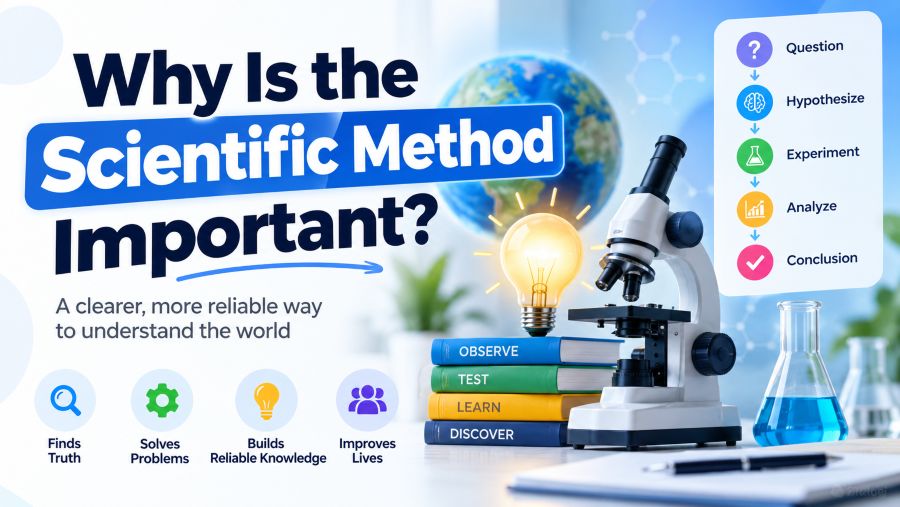
Why is the scientific method important? It gives people a reliable way to ask questions, test ideas, and separate evidence from opinion. Instead of depending on guesses, traditions, or personal beliefs alone, it encourages careful observation and logical reasoning.
This matters because human judgment can be biased. We often notice information that confirms what we already think and ignore details that challenge us. The scientific method helps reduce that problem by requiring evidence, testing, and review.
From medicine and technology to climate research and everyday problem-solving, this process supports better decisions. It does not promise instant certainty, but it does create a disciplined path toward stronger answers.
In a world full of claims, trends, and misinformation, the scientific method remains one of the best tools for finding out what is likely to be true.
The scientific method begins with curiosity. A person notices something, asks a question, and looks for a way to understand it more clearly.
That question leads to a hypothesis, which is a testable explanation. A good hypothesis can be checked through observation, measurement, or experiment.
Testing is what makes the process powerful. Instead of simply arguing that an idea sounds right, researchers collect data to see whether the evidence supports it.
The results may confirm the hypothesis, challenge it, or reveal that the question needs to be asked in a better way. Each outcome still adds value because it improves understanding.
This process is important because it is repeatable. Other people can examine the same evidence, repeat the test, and see whether the conclusion holds up.
Why Does Science Need a Method?
It Creates Order From Questions
The world is complex, and many questions have more than one possible answer. The scientific method creates an organized path from curiosity to evidence. By moving step by step, it helps researchers avoid jumping to conclusions too quickly.
It Reduces Personal Bias
People bring expectations, emotions, and assumptions into the way they interpret information. The scientific method limits those influences by requiring clear tests and measurable results. This makes conclusions less dependent on one person's opinion.
It Makes Ideas Testable
A scientific claim must be possible to examine through evidence. If an idea cannot be tested or challenged, it cannot be evaluated in a scientific way. This requirement keeps science grounded in reality rather than speculation.
It Supports Reliable Evidence
Evidence becomes stronger when it is collected carefully and interpreted honestly. The scientific method encourages controlled conditions, accurate measurement, and transparent reporting. These habits make findings more trustworthy.
It Allows Mistakes to Be Found
Science advances partly because errors can be detected. When researchers share methods and results, others can check their work. This openness helps correct weak conclusions and strengthen better ones over time.
It Builds Knowledge Gradually
Scientific understanding rarely appears all at once. Each experiment adds a piece to a larger picture. The scientific method helps knowledge grow in a careful, cumulative way, with later discoveries building on earlier evidence.
How It Shapes Better Thinking
1. The scientific method teaches people to ask clear questions before accepting easy answers.
2. It encourages evidence-based reasoning instead of relying only on assumptions or emotions.
3. It helps people compare possible explanations and choose the one best supported by facts.
4. It makes uncertainty easier to manage because conclusions can change when new evidence appears.
5. It strengthens critical thinking in school, work, health decisions, and public discussions.
Benefits Beyond the Laboratory
- Better decisions: People can use scientific thinking to weigh evidence before making choices about health, safety, money, or technology.
- Stronger problem-solving: The method encourages testing possible solutions instead of relying on the first idea that seems convenient.
- Greater accountability: Claims become more credible when people can explain how they reached their conclusions and what evidence supports them.
- Improved innovation: Many inventions develop through repeated testing, failure, adjustment, and learning from results.
- Public trust: Transparent methods help communities understand why scientific recommendations are made.
- Lifelong learning: The process reminds people that knowledge can improve as better evidence becomes available.
Where It Matters Most Today
Medicine and Public Health
Doctors and researchers depend on the scientific method to test treatments, compare outcomes, and identify risks. Clinical trials, vaccine research, and disease prevention all require careful evidence before recommendations can be made responsibly.
Education and Learning
Students who learn the scientific method gain more than science knowledge. They learn how to question claims, design fair tests, and explain their reasoning. These skills support stronger learning across many subjects.
Technology Development
Engineers and designers use scientific thinking when they test prototypes, measure performance, and improve systems. Whether the goal is a safer car or a better phone battery, progress depends on evidence and iteration.
Environmental Decisions
Environmental challenges require accurate data about air, water, ecosystems, and climate. The scientific method helps communities understand causes, measure changes, and evaluate which solutions are most likely to work.
Business and Product Testing
Companies use experiments to understand customer behavior, product quality, and operational efficiency. A careful testing process reduces guesswork and helps teams make decisions based on real results rather than internal opinions.
Everyday Claims Online
People encounter health tips, statistics, product promises, and viral claims every day. Scientific thinking helps readers pause, check evidence, and ask whether a claim has been tested fairly before believing or sharing it.
Policy and Society
Public policy affects large groups of people, so decisions should be informed by dependable evidence. The scientific method helps leaders evaluate problems, test interventions, and adjust plans when results show a better path.
The scientific method is important because it gives people a disciplined way to search for truth. It turns curiosity into investigation and transforms uncertain ideas into testable claims.
Its value reaches far beyond professional science. Anyone can benefit from asking better questions, looking for evidence, and being willing to revise a belief when the facts change.
The method does not remove all uncertainty, and it does not make people perfect. What it does is create a process that is more reliable than guesswork.
That is why the scientific method remains essential in research, education, decision-making, and daily life.
FAQs About why is the scientific method important
Why is the scientific method important in simple terms?
The scientific method is important because it helps people find reliable answers by asking questions, testing ideas, collecting evidence, and checking whether conclusions are supported by facts.
How does the scientific method reduce bias?
It reduces bias by requiring testable hypotheses, careful measurement, and repeatable procedures. This makes it harder for personal opinions or expectations to control the final conclusion.
Why is the scientific method important for students?
It teaches students how to think critically, solve problems, and support their answers with evidence. These skills are useful in science classes and in everyday decision-making.
Can the scientific method be used outside science?
Yes. People can use it in business, education, personal decisions, and practical problem-solving whenever they need to test an idea and learn from evidence.
What happens if scientists do not use the scientific method?
Without a clear method, conclusions may rely too much on opinion, coincidence, or incomplete information. This can lead to unreliable results and poor decisions.
Does the scientific method always prove something is true?
No. It usually shows whether the available evidence supports or challenges an idea. Scientific conclusions can change when stronger evidence appears.